

By: Jenny Avendaño
Published by Radco Comics, A Girl Walks Home At Night #1 “Death Is The Answer,” is a masterfully crafted abyss brought forth by Ana Lily Amirpour, with art by Michael Deweese, and dauntless lettering by Patrick Brosseau. What Amirpour herself directed as the “first Iranian vampire western” echoing of the Beatnik tradition has been converted into a literary and visual retelling in the comic medium. Undeniably, first of its kind for many reasons, including stylistic ingenuity and reinventing of the genre itself through hauntingly beautiful visualization.
On the surface, this narrative seems utterly minimalistic; a black and white sketch rendition that opens with paneless and borderless sequential art accompanied by captionless, all capitalized text. Moreover, with hardly any words a sense of oblivion takes over, as the spectator cannot help but succumb to modern dread. The color saturation itself seems reversed and it is not clear whether it is black on white or white on black, creating the illusion of being trapped in a noir horror film. Amirpour’s cinema expertise and connection to the story allows for an effortless parallel between film, text, and artwork.
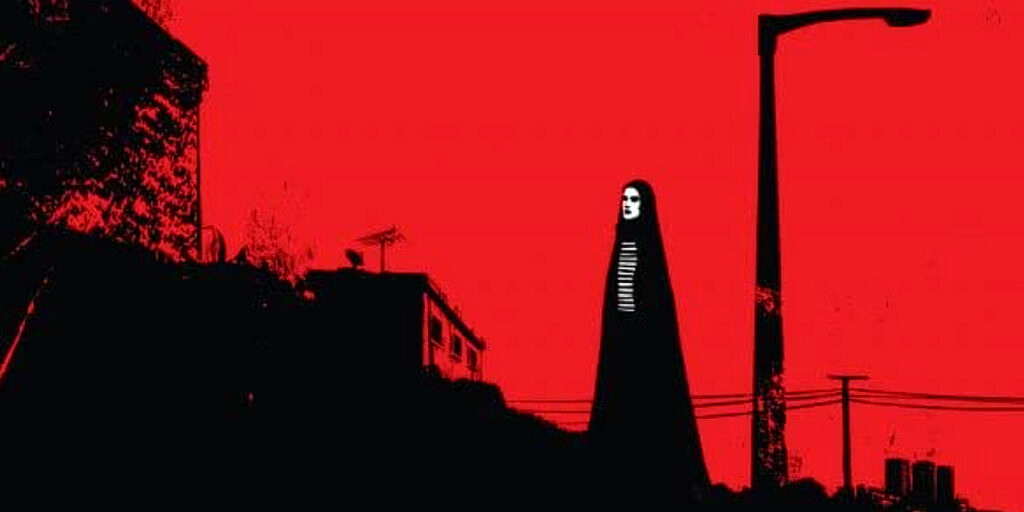
For instance, as the story unravels with our counterculture protagonist, a vampire girl who lives in Bad City, “A place that reeks of death and loneliness,” one willingly dives into this existential oblivion. A morbid quest questioning morality through the actions of a girl who would have been a victim in any other narrative. A girl walking home alone embodies vulnerability and weakness, however, in this tale, the fate of the corrupt is in her hands. She is morbid yet aesthetically alluring; her eyes depicted in a tub filled with water and then presented in full splendor surrounded by butterflies. This girl should be condemned but the reader willfully absolves her of all faults because of underlying judgment. Amirpour portrays this antihero with an archetypal agency that highlights the potential for good amongst the wicked.
So much is being said with so little, the girl who rides a skateboard and watches bad men prey on the weak becomes something sinister, “The one who is watching you. The one who knows your darkest secret. The one who will come for you.” The catacombs of the mind cannot help but serve to fill in the blanks of what is left unsaid, ultimately taking part in the realization of this tale. One can ultimately relate more to this pariah vigilante than the slaughtered predators.

The cover alone demands interpretive attention, setting the tone with a three-color palette that provokes the reader’s subconscious thoughts. I am absolutely fascinated with Covers A and B because Deweese’s abstraction serves as a perfect lure for human curiosity. A critical read for anyone seeking universal truth that will simply transform any preconceived notion regarding the role of comics.


